Using interdental brushes
Ordinary brushing with a toothbrush, even an electric one, is not always enough to remove plaque and food debris effectively. The spaces between the teeth are often hard to reach and allow bacteria to build up, causing decay and gum disease. This is why interdental brushes are a simple, effective solution. They complete daily cleaning, protect the gums and help keep the mouth healthy in the long term.
Understanding the role of interdental brushes
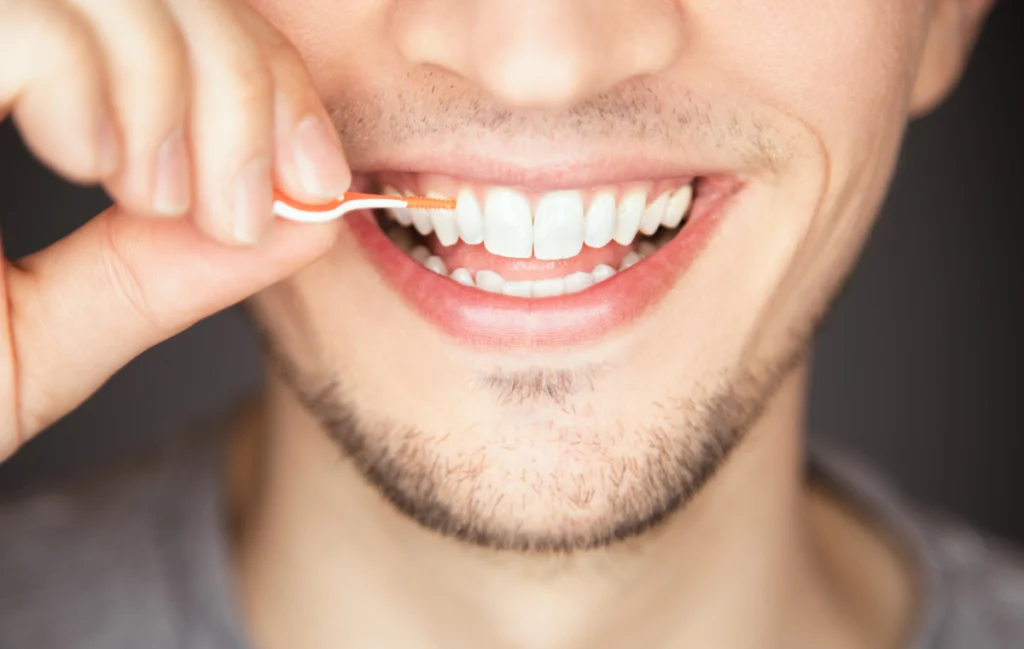
Interdental brushes are small tools with a thin handle and a cylindrical or conical brush head. As they come in several sizes, they adapt to the spaces between the teeth. They provide gentle mechanical cleaning without the need for any additional products.
Unlike dental floss, which is often harder to handle, interdental brushes are simple and intuitive to use. They are suitable for natural teeth as well as for people with prostheses, implants or braces.
When to use interdental brushes
Interdental brushes fit easily into a daily hygiene routine. As a rule, the evening is the best time, as this limits plaque build-up overnight. Some people choose to use them after every meal for even more thorough cleaning.
They are particularly useful for patients who have:
- wider spaces between their teeth;
- a tendency towards gum inflammation;
- a history of gum disease;
- orthodontic treatment or restorations (crowns, bridges, implants).
Choosing the right size
Each space between the teeth has its own shape, so the effectiveness of interdental brushes depends on choosing the right size. A brush that is too thin will not clean properly, while one that is too wide can injure the gum.
It is best to try several diameters and adapt the brush to each area. Dentists often recommend several different sizes to cover all the teeth, so that cleaning stays precise and gentle on the gums.
How to use interdental brushes

To clean effectively and avoid irritation, follow a few simple steps:
- Insert the brush gently into the space between the teeth, without forcing it.
- Move it back and forth horizontally once or twice.
- Rinse the brush after each space.
- Replace the brush if it becomes bent or less effective.
Never push the brush in roughly. Using it should remain comfortable.
Combining interdental brushes with other cleaning methods
Interdental brushes do not replace a toothbrush; they complement it. Together, they remove around 90% of dental plaque, compared with only 60% with brushing alone.
Dental floss is still useful, especially in very tight spaces where brushes do not fit. Some dentists also recommend a suitable mouthwash to further help prevent inflammation.
Adapting interdental brushes to age
Needs vary depending on each person’s situation:
- Children do not usually need interdental brushes until their permanent teeth are in place and while the spaces remain narrow.
- For teenagers, especially those wearing braces, they become very useful for removing plaque around the brackets and wires.
- For adults, they are an everyday tool for preventing gingivitis and periodontitis.
- For older people, they make it easier to clean around prostheses or implants.
Hygiene and lifespan of interdental brushes
An interdental brush should be replaced regularly. On average, it remains effective for five to ten days, depending on use. As soon as the bristles wear, it becomes less effective and should be changed.
After each use, rinse it with clean water and let it air-dry. Some models have a protective cap, which makes them easier to carry and more hygienic.
Interdental brushes and preventing oral disease
Plaque build-up between the teeth is one of the main causes of gingivitis. If it is not removed, it can eventually lead to periodontitis and receding gums.
By cleaning between the teeth every day, interdental brushes help to:
- reduce gum inflammation and bleeding;
- limit decay on the sides of the teeth;
- keep breath fresher;
- extend the life of dental restorations.
Common mistakes to avoid
Despite their simplicity, some mistakes are common when using interdental brushes:
- Using the wrong size.
- Forcing the brush in and damaging the gum.
- Using the same brush for too long.
- Only cleaning one area of the mouth.
Taking the time to learn the right technique is essential for effective, lasting results.
Interdental brushes FAQ
- Should interdental brushes be used every day?
Yes, daily use is recommended to maintain good oral hygiene.
- Can dental floss replace interdental brushes?
Floss is useful in some very tight spaces, but interdental brushes are more effective for most spaces between the teeth.
- Are interdental brushes suitable for sensitive gums?
Yes, provided you choose the right size and use them gently.
- Can an interdental brush be reused?
Yes, but only for a few days. As soon as it is worn or bent, replace it.
- Should toothpaste be used with interdental brushes?
No, they can be used dry or with a little water. Some people use a specific fluoride gel, but only on their dentist’s advice.
Looking after your oral hygiene every day
Adding interdental brushes to your routine is a simple, effective way to protect the health of your teeth and gums. They complement ordinary brushing and reach the most difficult areas. For personalised follow-up and advice, you can see Dr Lisa Baure and Dr Jean-Michel Heurtebise at the Cabinet dentaire du Lys in Juan-les-Pins. Appointments can easily be booked online.