Teeth whitening
Teeth whitening lightens the colour of the teeth to make the smile brighter and more harmonious. It does not produce a radical transformation, but it reduces the discolouration that builds up over time.
These stains often appear after drinking coffee, tea or red wine, or after smoking. Sometimes they also result from a genetic predisposition.
The treatment uses peroxide-based gels, carefully dosed by the dentist. These gels release oxygen, which acts directly on the pigments responsible for the stains. The process does not alter the internal structure of the tooth but gradually lightens its shade. With careful follow-up, the dentist aims for a natural, even result.
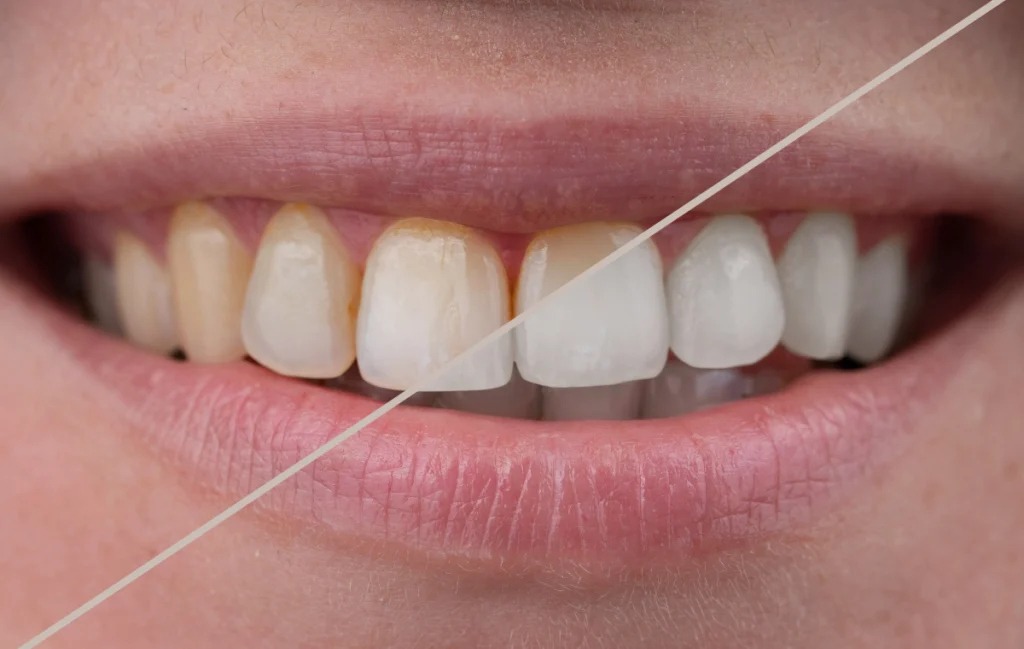
Why do teeth change colour?
Tooth colour varies from person to person and changes over the years. There are several reasons for this:
- Food and drink: some products rich in colourings penetrate the outer layers of the enamel.
- Smoking: nicotine and tar leave yellowish or brownish deposits.
- Ageing: enamel becomes thinner and reveals the darker dentine underneath.
- Medication: some substances, such as tetracyclines taken in childhood, cause lasting discolouration.
- Genetic predisposition: the natural colour of teeth varies with heredity.
Understanding where the stains come from helps determine whether whitening is a suitable option.
How whitening works
Teeth whitening should never be improvised: it must always be carried out under the supervision of a dentist. Before starting, the dentist examines the whole mouth to make sure there is no decay, infection or gum inflammation. Treatment can only be carried out on healthy teeth and tissues, for safe and effective care.
The process then follows several successive steps:
- Diagnosis and initial assessment
The dentist records the starting shade and sets a realistic goal in line with the patient’s expectations. This step makes it possible to adapt the method and the concentration of the product. - Preparing the mouth
Before whitening, the dentist carries out thorough scaling and polishing. This preliminary care removes deposits that could reduce the effectiveness of the whitening gel. - Applying the whitening gel
The dentist applies the gel to the surface of the teeth after carefully protecting the gums. Depending on the technique, the product may be activated with a special light. - Follow-up at home
Finally, the dentist may recommend wearing custom-made trays to continue the treatment at home for several days. This step allows a gradual, even result.
This supervised protocol allows a gradual result and limits the risk of sensitivity.
The different whitening methods
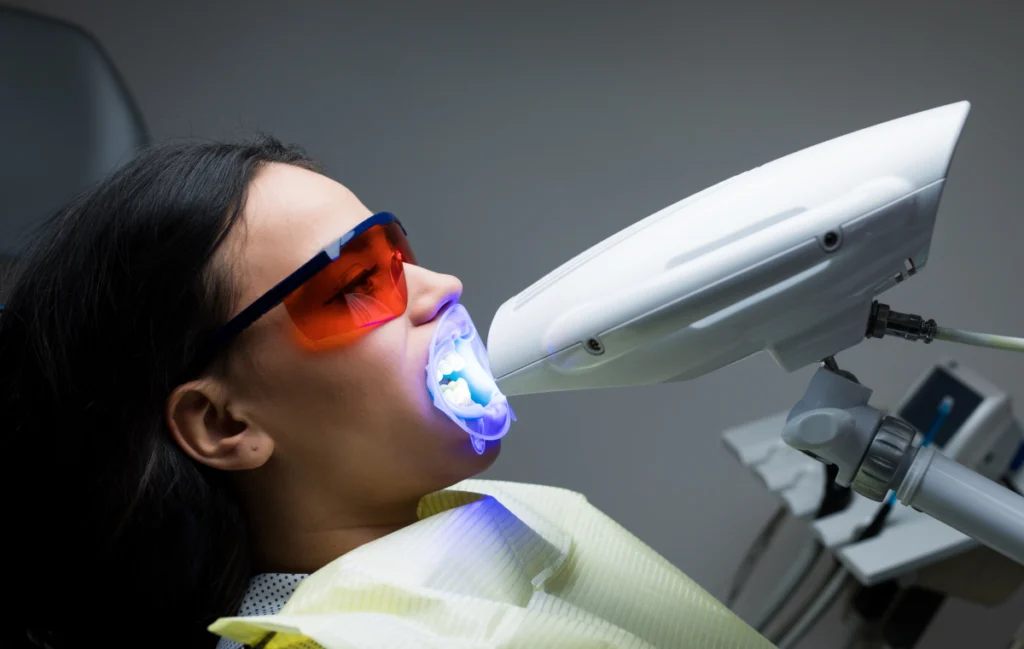
Several approaches are available to suit each patient’s needs:
- In the practice: a session of about one hour, applying concentrated products under professional supervision.
- At home with trays: the dentist provides a custom-made device and a gel to use over a set period.
- Combined approach: a session at the practice followed by additional treatment at home.
These techniques do not all work at the same speed, but they share the same goal: to gradually lighten the shade of the teeth while preserving their integrity.
Precautions
Whitening should never be undertaken without medical supervision. Some situations call for particular care:
- Pregnant or breastfeeding women: treatment is usually postponed.
- Decay or tooth wear: these must be treated first.
- Very sensitive teeth: adapted protocols or a temporary pause may be needed.
- Crowns and composite fillings: these restorations do not lighten and may need adjusting afterwards to match.
The dentist’s role is to explain clearly what whitening can and cannot do, to avoid any disappointment.
Expected results and limitations of whitening
Whitening can lighten the shade of the teeth by several tones, making the smile brighter. However, it does not produce a uniform, absolute white. The result depends on the initial shade and on how each person responds.
In general, the improvement lasts two to five years. Eating habits, hygiene and smoking have a direct influence on how long it lasts. The dentist may suggest occasional touch-ups to prolong the effect.
Possible side effects
Whitening is a safe treatment when supervised by a professional, but some temporary discomfort may occur:
- Temporary tooth sensitivity, especially with cold or acidic foods and drinks.
- Gum irritation, due to accidental contact between the gel and the gum.
- Uneven shade, if some areas respond more than others.
These effects usually disappear within a few days. The dentist may suggest desensitising products or adjust the protocol for greater comfort.
Tips to make the results last
After whitening, a few simple habits help keep your smile bright for longer:
- Limit coffee, tea, red wine and coloured fizzy drinks.
- Cut down on or stop smoking.
- Brush your teeth after every meal with a suitable toothpaste.
- Have regular scaling at the dentist.
- Use a straw for dark drinks to limit contact with your teeth.
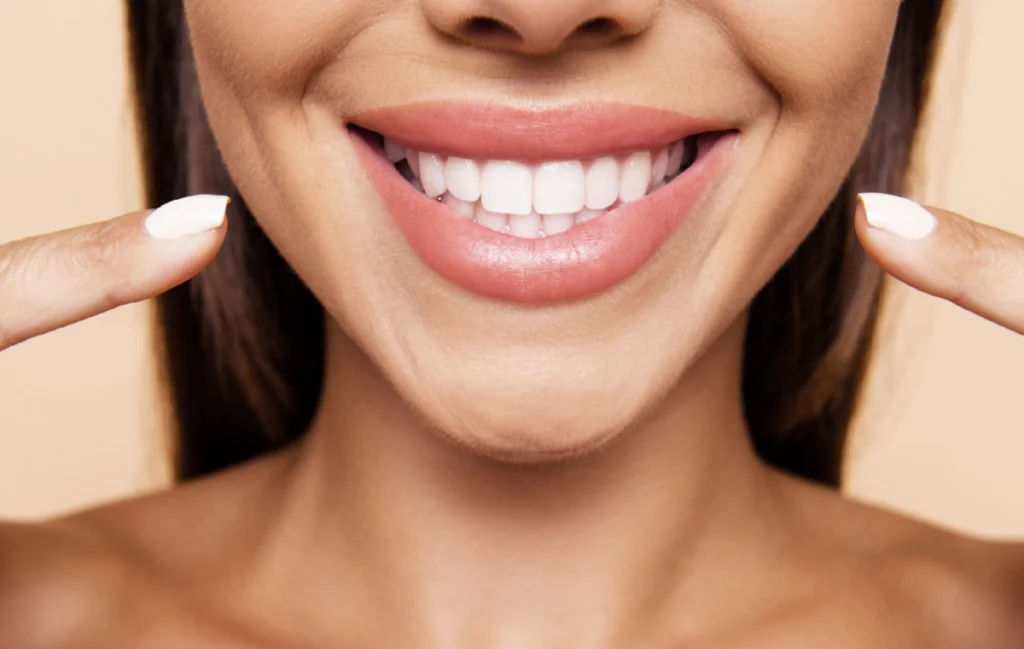
Together with careful daily oral hygiene, these habits help the shade stay stable for longer.
Whitening and dental health
Whitening only changes the shade of the teeth. It does not replace routine dental care and does not treat dental disease, so the dentist must treat any problem before whitening begins.
Enamel is not weakened when treatment is properly supervised. Using suitable, approved products helps protect the teeth.
Teeth whitening FAQ
- Is whitening painful?
It is not usually painful, but temporary sensitivity may occur. It generally disappears within a few days.
- How long do the results last?
Between two and five years, depending on eating habits, hygiene and smoking.
- Can all teeth be whitened?
Natural teeth respond to treatment. Prostheses and restorations do not change colour.
- Is whitening suitable for everyone?
It is not recommended for children, pregnant women or in the presence of untreated dental disease.
- Can I whiten my teeth at home without a dentist’s advice?
Over-the-counter products are not recommended: they are often ineffective and sometimes irritating. Professional supervision is the safest approach.
Book an appointment for teeth whitening
If you would like a brighter smile, start by asking a dentist’s advice. They will check the condition of your teeth, choose the right method and provide tailored follow-up.
You can book a consultation online now with Dr Lisa Baure and Dr Jean-Michel Heurtebise at the Cabinet dentaire du Lys in Juan-les-Pins.
You may also be interested in: