Immediate extraction and implant placement
Immediate extraction and implant placement means removing a tooth that can no longer be saved and, in the same appointment, placing an implant that will later support a new tooth. By combining two steps into one, this protocol shortens the time between extraction and implant placement, so the patient regains comfortable chewing and a natural-looking smile more quickly.
Unlike traditional methods, where several weeks pass before the implant is placed, this approach speeds up treatment. It does, however, depend on two key conditions: good bone quality and solid initial stability of the implant.
When can immediate extraction and implant placement be considered?
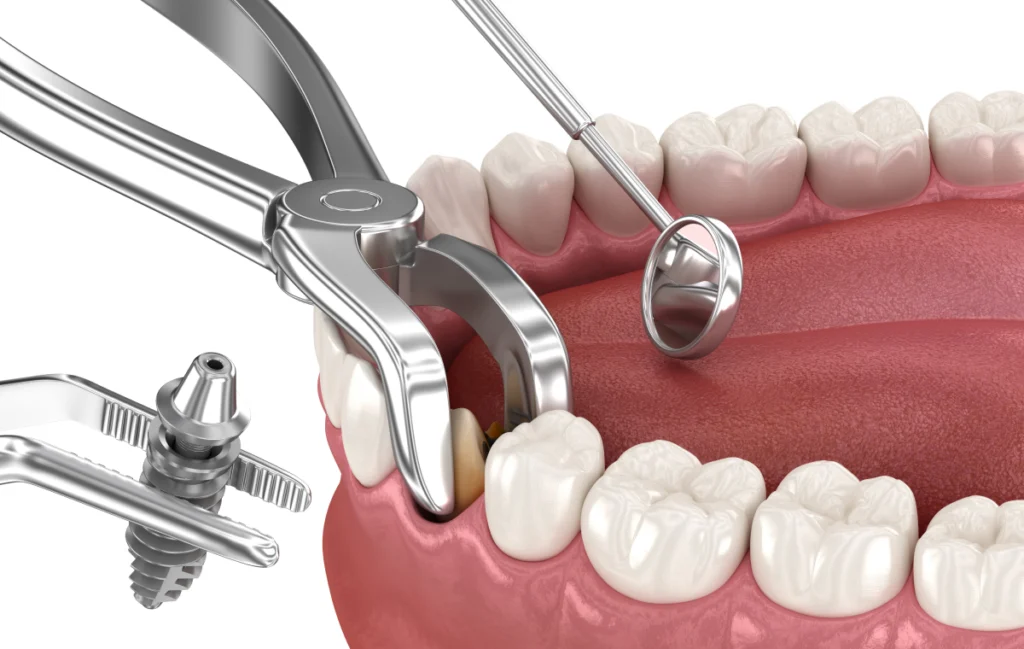
Whether this technique is suitable depends on each clinical situation. Immediate extraction and implant placement may be considered when the tooth has:
- a fracture that means it cannot be saved;
- decay too deep to be restored;
- severe gum disease affecting its stability.
Incisors and premolars are most often concerned, as they play a direct role in the appearance of the smile. However, the condition of the bone after extraction and the absence of acute infection determine whether it is possible. In short, only a clinical and X-ray assessment can guide the decision.
How immediate extraction and implant placement works
Step 1: initial assessment
The dentist begins with a full assessment, including a clinical examination, X-rays and sometimes a 3D scan, to check the available bone density and the health of the gums.
Step 2: careful extraction
The dentist removes the tooth gently to preserve the surrounding bone and gum. This atraumatic extraction helps the future implant to be stable.
Step 3: placing the implant
Immediately after the extraction, the dentist inserts the implant into the socket. Its mechanical stability is checked and, if needed, guided bone regeneration is used to fill any gaps.
Step 4: healing
After placement, the implant gradually integrates with the bone. During this period, a temporary tooth may be offered to maintain appearance and function.
Healing after immediate extraction and implant placement
Healing corresponds to osseointegration, the process by which the implant becomes anchored in the bone. It takes from a few weeks to several months, depending on bone density and the position of the tooth. During this phase, the patient needs to follow specific instructions: keep up careful oral hygiene, avoid chewing hard foods and protect the treated area.
Regular follow-up appointments make it possible to check progress and ensure that the implant is integrating properly.
Follow-up after immediate extraction and implant placement
Follow-up plays a major role in the success of treatment. The dentist sees the patient at regular intervals to check healing and the condition of the tissues. X-rays are used to confirm that the implant has integrated with the bone.
Once healing is satisfactory, the dentist fits the final crown or bridge, which restores chewing and the appearance of the smile. Follow-up continues even after the restoration is fitted, to help the treatment last.
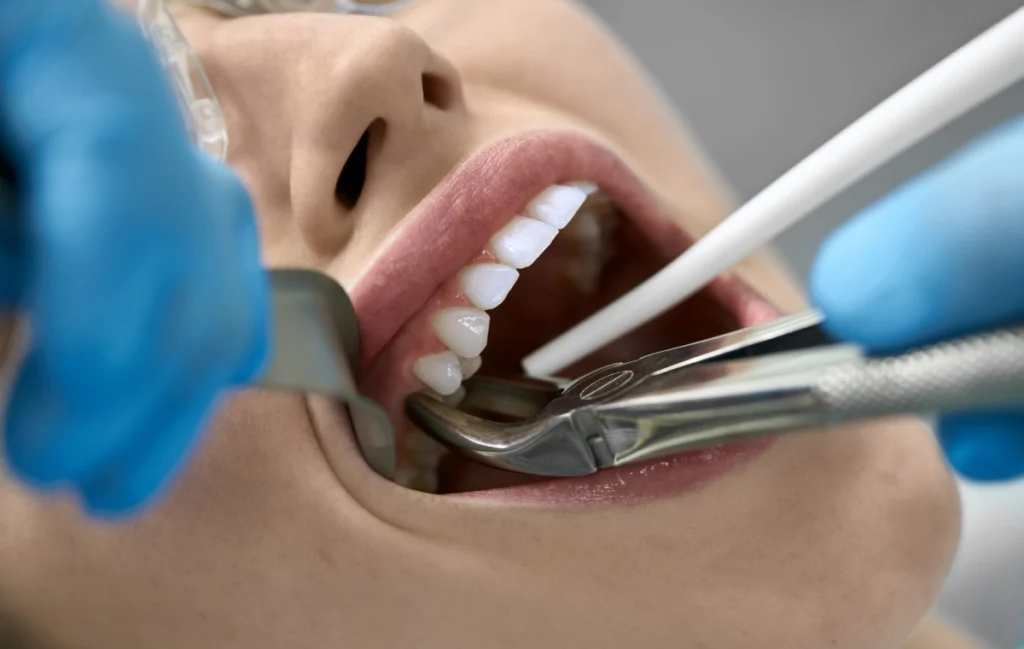
Oral hygiene and precautions
Appropriate oral hygiene directly supports the success of treatment. The patient should therefore:
- brush their teeth carefully two to three times a day;
- use suitable interdental brushes;
- follow the dentist’s advice on mouthwash.
It is also best to avoid smoking, which slows healing, and very hard foods in the days following the procedure. These precautions support healthy gums and a stable implant.
Key points about immediate extraction and implant placement
This approach reduces the number of appointments needed and shortens the overall treatment time. However, it is not suitable for every situation: the dentist must make sure that the bone and soft tissues allow the implant to be stabilised properly.
Patients also play an active role. By following post-operative instructions and maintaining careful oral hygiene, they contribute directly to the success of the treatment.
Frequently asked questions (FAQ)
Is immediate extraction and implant placement painful?
The procedure is carried out under local anaesthetic, so you should not feel pain during treatment. Some discomfort may follow, but it is usually well controlled with suitable painkillers.
Can a temporary tooth be fitted on the same day?
In some cases, a temporary tooth can be placed immediately after the implant, particularly to preserve the appearance of the smile. This depends on the stability achieved and the condition of the treated area.
How long before the final crown or bridge can be fitted?
The timing depends on how the bone heals. It generally ranges from a few weeks to several months, depending on the position of the implant and bone density.
What are the main risks?
As with any surgical procedure, there are risks: infection, failure of the implant to integrate, or bone loss. These remain rare when a thorough assessment is carried out beforehand and instructions are followed.
Book a consultation
If you are considering immediate implant placement or would like to know more about this approach, a personal consultation is essential to assess your situation and determine the most suitable treatment. For any enquiry, you can contact Dr Lisa Baure and Dr Jean-Michel Heurtebise at the Cabinet dentaire du Lys in Juan-les-Pins and book an appointment online.
You may also be interested in: